EMR W64544-SL1-1 Vhf Plexer Single Isolator
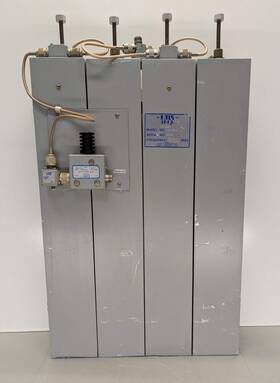
( Brand: Emr ), ( Manufacturer Part Number: W64544-SL1-1 ), ( Color: Grey ), ( Power: 150w ), ( Type: Infrastructure )
Review EMR Vhf Iso plexer Single stage Isolator
The **EMR W64544-SL1-1 VHF ISO-Plexer (Single-Stage Isolator)** is a high-performance, compact microwave component designed to provide robust isolation and signal integrity in demanding VHF (Very High Frequency) applications. Engineered for reliability and precision, this isolator operates within the 136 174 MHz frequency range, making it an ideal solution for military, aerospace, and commercial communications systems where signal leakage and back-reflection must be minimized. Its single-stage ferrite isolator architecture ensures efficient unidirectional signal flow, allowing maximum forward transmission while suppressing reverse signals by up to 20 dB or more, depending on the operating conditions. Constructed with high-purity materials and precision-machined components, the W64544-SL1-1 delivers exceptional thermal stability and consistent performance across a wide temperature range, ensuring dependable operation in harsh environments. The device features a rugged, hermetically sealed enclosure with a robust flange mount, providing durability against vibration, shock, and environmental contaminants. Its compact and lightweight design allows for seamless integration into existing RF systems, whether in ground-based radar networks, satellite communications, or airborne radar platforms. With minimal insertion loss (typically under 1.5 dB) and superior isolation characteristics, this isolator ensures optimal signal purity, reducing interference and enhancing overall system efficiency. Whether deployed in military C4ISR (Command, Control, Communications, Computers, Intelligence, Surveillance, and Reconnaissance) systems or commercial infrastructure, the EMR W64544-SL1-1 VHF ISO-Plexer stands as a critical component for maintaining signal integrity in mission-critical applications.
### **Pros and Cons of buying a EMR W64544-SL1-1 (VHF ISO-Plexer Single-Stage Isolator)**
#### **Pros:**1. **High Isolation Performance** The single-stage isolator is designed to provide strong isolation between the transmitter and receiver, reducing interference and improving signal integrity in VHF applications. This is particularly useful in environments with multiple radios or strong external signals.
2. **Compact and Lightweight Design** The ISO-Plexer architecture allows for a smaller and more portable solution compared to traditional duplexers or circulators, making it easier to integrate into mobile or handheld systems.
3. **Wide Bandwidth Coverage** The unit is optimized for VHF frequencies, which is a common range for aviation, marine, and land mobile radio systems. This ensures compatibility with a broad range of applications without requiring frequency-specific tuning.
4. **Durability and Reliability** Built for rugged use, the isolator is likely constructed with materials and components that can withstand harsh environmental conditions, including temperature fluctuations, vibration, and moisture.
5. **Cost-Effective for Specific Applications** While not as versatile as a duplexer, an isolator can be a more affordable solution when only one-way isolation is required, rather than full duplex operation.
6. **Easy Installation** The modular design simplifies integration into existing radio systems, reducing the complexity of wiring and setup compared to more complex RF components.
7. **Reduced Backward Power** By preventing reflected signals from traveling back into the transmitter, the isolator helps protect sensitive components from damage caused by impedance mismatches or strong reflections.
---
#### **Cons:**1. **Limited to One-Way Isolation** Unlike a duplexer, which allows simultaneous transmission and reception, an isolator only prevents signals from traveling backward in one direction. This means it cannot fully replace a duplexer in applications requiring full duplex operation.
2. **Frequency-Specific Performance** While it covers VHF, its effectiveness may degrade if used outside its specified frequency range. Unlike broadband solutions, it may not handle wideband or multi-band applications as effectively.
3. **Potential for Signal Loss** Isolators introduce some insertion loss, which can slightly reduce the overall signal strength compared to a direct connection or a more efficient RF component like a circulator.
4. **Limited Bandwidth Flexibility** If the application requires tuning across multiple sub-bands within VHF, the fixed design of the isolator may not offer the same adaptability as tunable or broadband duplexers.
5. **Potential for Overheating in High-Power Applications** In systems with very high RF power levels, the isolator s single-stage design may generate more heat than multi-stage or circulator-based solutions, requiring additional cooling or derating.
6. **Compatibility with Existing Systems** Depending on the specific radio or antenna setup, the isolator may require additional components (e.g., filters, combiners) to function optimally, adding complexity to the system design.
7. **Higher Cost Than Basic Filters** While cheaper than duplexers or circulators, the isolator is still a specialized RF component and may be more expensive than basic RF filters or simple isolators without the ISO-Plexer architecture.
---
### **Conclusion:**The **EMR W64544-SL1-1 VHF ISO-Plexer Single-Stage Isolator** is a specialized RF component best suited for applications where **unidirectional isolation** is the primary requirement, such as preventing transmitter leakage into sensitive receiver paths in VHF systems. Its compact design, high isolation performance, and ruggedness make it ideal for mobile, aviation, or marine applications where space and weight are concerns. However, it is not a replacement for duplexers in full-duplex systems and may introduce slight signal loss or require additional components for optimal performance.
### **Recommendation:** - **Buy if:**- You need a **simple, cost-effective solution** for isolating a transmitter from a receiver in a VHF system (e.g., preventing transmitter bleed-through in a shared antenna setup).
- Your application **does not require full duplex operation**, and you prioritize compactness and ease of integration.
- You are working in an environment where **interference suppression** is critical, and the isolator s performance meets your isolation requirements.
- **Avoid if:**- You require **bidirectional isolation or full duplex operation**, in which case a **duplexer or circulator** would be more appropriate.
- Your system operates at **high power levels** where multi-stage isolators or circulators would be more efficient and reliable.
- You need **broadband or tunable RF solutions**, as this isolator is fixed-frequency and may not cover all your frequency needs.
- **Consider Alternatives:**- If you need **full duplex operation**, evaluate a **duplexer** (e.g., EMR W64545-SL1-1) or a **circulator**.
- If cost is a major concern, explore **basic RF filters or passive isolators** that may offer similar isolation with lower complexity.
- For **multi-band or wideband applications**, a **broadband isolator or circulator** may be more versatile.
Ultimately, the **EMR W64544-SL1-1 is a strong choice for targeted VHF isolation needs** but should be carefully assessed against the specific requirements of your RF system.
Details:
In/Output Connectors: N Female. Used radios-live. Whats Included: EMR W64544-SL1-1 VHF Iso-Plexer with Single-Stage Isolator 30-day warranty Duplexes Details: model Number: Frequency Range: 144-190MHz Offset Min-Max.: 1 - 10 MHz Insertion Loss Max.: 1.2 dB Isolation TX-Rx Min. Isolator Details.
Band width : Single Frequency. EMR W64544-SL1-1 VHF Iso-Plexer with Single-Stage Isolator: pass-notch duplexes allow for the simultaneous use of a transmitter and receiver on single common antenna. Money Back Or Replacement. Tuning is available upon request.
This duplexes was pulled from a working system and is in excellent condition.
part #: w64544sl11 price
- $1495.00
specifications twowayradiobob:
- brand: Emr
- mpn: W64544-sl1-1
- color: Grey
- power: 150w
- type: Infrastructure
returns twowayradiobob:
- policy: Returns Accepted
- method: Money back
- paid by: Buyer
- time: 30 Days
seller twowayradiobob:
- city: Denver, Colorado
- # reviews: 21945
- rating: 99.8%
general twowayradiobob:
- Consumer Electronics > Radio Communication > Walkie Talkies, Two-Way Radios
- condition: Used
offer twowayradiobob:
- sold: 0
- availability: In Stock
- options: Ship-to-home
- started: June 3, 2026
- quantity: 1
payments twowayradiobob:
- other
- wallet: Paypal
- credit card: Visa
shipping twowayradiobob:
- cost: $350.00
- class: Standard
- transit: 9-15 Days
- service: Standard
- type: Fixed
Emr W64544-SL1-1 Is Similar To:
- 64544-snc Emr Corp Vhf Duplexer (40.4% similar) Filters are in excellent condition, were used and have been stored climate controlled frequency range: 144-190MHZ input power max: 150 watts insertion loss TX-Rx ant: spacing: 80DBVSWR max: 8/1 5MHZISOLATION typ: 85DBISOLATION min. 2:1 or better separation min-max: MHz resonators size qty...(July 23rd, 2017)
- 64546-snc Emr Corp Vhf Duplexer (38.2% similar) 2:1 impedance 50 ohm n female connectors 19 rack mount. 6 db TX insertion loss at 500 khz spacing, operating temp range 20 to 50 c will tune your repeater frequency, no charge. Min isolation db max vst Emr vhf duplexes MHz min channel spacing 500 khz 150 watts power 6 db Rx insertion loss at 500 ...(August 24th, 2017)
- W7440-0 Emr Corp New Circulator Isolator Vhf Mhz Tunes To Meters (29.5% similar) New Emr corp circulatory isolator vhf W7440 MHz tunes to 2 meters with deep null of...(October 31st, 2018)
- Emr 840622 Vhf Bi-directional Amplifier 150-176 Mhz 5 Watts Model (34.1% similar) FCC classification class booster. Emr bi-directional amplifiers beads provide two way applicant down link filtering and amplification of RF signals in buildings, tunnels areas that are shaded from adequate signal coverage. Emr vhf bi-directional amplifier 150-176 MHz 5 watts model 840622. Rf ...(November 14th, 2023)
- Emr 7480 6hf 6480 s Corp And R.f Isolator With Frequency 170.17500 Mhz Untested (30.4% similar) Testing: this item has not been tested. You don't love it. Isolator with frequency 170.17500 MHz untested, - this sale includes: 1 unit, condition: item is used and may have scratches or scuff marks. Item for sale: Emr corp 7480/6HF 6480/S r.f. Data: this units data has been sanitized if applicable...(May 14th, 2024)
- Used Radios 75524-sb-5 Emr Snc-3 Iso-plexer (31.7% similar) 8-CAVITIES: TX 3 band pass BP, Rx 2 BP pass-reject pr. Money back or replacement. Isolation: TX 73 db, Rx 105 db. Emr 75524-SB-5, SNC-3 iso-plexer: iso-lexers allow a transmitter and receiver to share common antenna allowing bi-directional duplex communication over single channel. Model number: ...(June 3rd, 2026)