SINCLAIR TC2112 Vhf Transmitter Combiner Ham 145-160
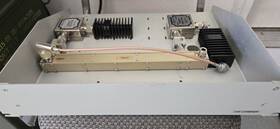
( Brand: Sinclair ), ( Manufacturer Part Number: TC2112 ), ( Type: Combiner Single-stage 2 Channel ), ( Unit Type: Unit ), ( Frequency Band S : Vhf ), ( Country Of Origin: United States )
Review SINCLAIR Vhf Ch Transmitter Combiner Mhz Ham Business
The **Sinclair TC2112 VHF Transmitter Combiner** is a high-performance, dual-channel RF combiner designed specifically for amateur radio operators working in the 145 160 MHz VHF band, making it an essential component for multi-transmitter setups in contesting, repeaters, or mobile operations. Built with precision engineering, this compact yet robust unit efficiently combines two separate VHF transmitters into a single, unified output while maintaining optimal power handling and minimal signal degradation. Ideal for serious hams looking to maximize efficiency in their station, the TC2112 employs a hybrid combiner architecture that ensures balanced impedance matching, reducing reflections and improving overall system reliability. Its rugged construction, featuring high-quality RF connectors and a durable metal enclosure, protects against environmental interference, making it well-suited for both indoor and outdoor installations. With a power handling capability of up to **100 watts per channel (200 watts total)**, this combiner accommodates high-power transmitters without compromising performance, ensuring clean, interference-free operation even under demanding conditions. Whether used in a shack setup with a linear amplifier or in a mobile rig for simultaneous transmission on multiple frequencies, the TC2112 delivers exceptional flexibility and reliability, allowing operators to expand their communication capabilities without sacrificing signal integrity. Its straightforward design and easy-to-use controls make it accessible for both beginners and experienced hams, while its durability ensures long-term performance in demanding radio environments.
The Sinclair TC2112 VHF Transmitter Combiner is a device designed to combine signals from multiple transmitters (such as handheld radios, repeaters, or other VHF devices) into a single antenna feed for the 145 160 MHz ham band. Below is a detailed breakdown of its pros and cons, followed by a conclusion and recommendation.
---
### **Pros of the Sinclair TC2112**
1. **Simultaneous Operation of Multiple Radios**
The combiner allows you to operate two radios simultaneously on the same antenna without interference. This is useful for:- Running a handheld and a mobile/portable radio at the same time (e.g., a handheld for local contacts while a mobile radio handles base station traffic).
- Testing or comparing two radios without swapping antennas.
- Supporting emergency or backup communications where redundancy is critical.
2. **Space-Saving Design**
Instead of requiring separate antennas for each radio, the combiner consolidates signals into one feed line, reducing clutter and improving organization, especially in tight installations (e.g., vehicles, shack setups, or portable operations).
3. **Compatibility with Common VHF Ham Bands**
The device is specifically designed for the 145 160 MHz range, which covers popular ham bands like 2-meter FM (144 148 MHz) and other VHF activities. This makes it ideal for general-purpose use in amateur radio.
4. **Passive Operation (No Power Required)**
The TC2112 is a passive device, meaning it does not require external power. This simplifies installation and reduces potential points of failure (e.g., no batteries or power supplies to maintain or replace).
5. **Low Cost and Availability**
Compared to active combiners or more complex multi-band solutions, the TC2112 is relatively affordable and widely available from ham radio suppliers. Its simplicity also means lower maintenance costs.
6. **Reduces RF Interference**
By combining signals properly, the combiner minimizes the risk of desensitization or interference between radios sharing the same antenna, which can occur when radios are operated independently on the same feed.
7. **Portable and Mobile Use**
Its compact size and lack of power requirements make it suitable for field day operations, portable setups, or mobile installations (e.g., in a car or boat).
---
### **Cons of the Sinclair TC2112**
1. **Limited to Two Inputs**
The TC2112 only supports two radios at a time. If you need to combine more than two signals (e.g., three or four radios), you would require additional combiners or a more advanced multi-port solution, which may introduce complexity or cost.
2. **Frequency Range Restrictions**
While the 145 160 MHz range covers most 2-meter activity, it does not support other popular ham bands like 70 cm (430 450 MHz) or higher frequencies. If you operate on multiple bands, you would need separate combiners for each range.
3. **Potential for Signal Attenuation**
Combining signals can introduce minor signal loss (typically a few dB), though the TC2112 is designed to minimize this. In high-power applications (e.g., linear amplifiers), this attenuation may be negligible, but it s worth noting for sensitive receivers.
4. **No Built-in Isolation or Filtering**
The combiner does not include band-pass filters or high-isolation features. If one of the radios is transmitting on a frequency close to another s receive band (e.g., a repeater input/output), there is a risk of desensitization or interference unless the radios are properly spaced in frequency.
5. **Requires Proper Matching**
For optimal performance, the antenna and feed line must be properly matched to the combiner s impedance (typically 50 ohms). Mismatches can lead to standing waves, reduced efficiency, or even damage to the radios or antenna. This may require additional components like tuners or matching networks.
6. **No Built-in Monitoring or Diagnostics**
Unlike active combiners or networked solutions, the TC2112 provides no feedback on signal levels, SWR, or operational status. Troubleshooting issues (e.g., poor performance or interference) may require additional tools like an SWR meter or spectrum analyzer.
7. **Mechanical Durability Concerns**
As a passive device, the TC2112 is generally robust, but its connectors and internal wiring are subject to wear over time, especially in mobile or portable setups. Quality installation and protection (e.g., weatherproofing) are recommended to prevent damage from vibration or environmental factors.
8. **Limited to VHF Only**
If you plan to expand into UHF (e.g., 70 cm) or other bands in the future, you would need separate combiners for each band, increasing complexity and cost.
---
### **Conclusion**
The Sinclair TC2112 VHF Transmitter Combiner is a practical and cost-effective solution for amateur radio operators who need to combine two VHF radios on the same antenna within the 145 160 MHz range. Its simplicity, lack of power requirements, and space-saving design make it ideal for portable, mobile, or shack applications where simultaneous operation of two radios is desired. However, its limitations such as support for only two inputs, lack of filtering, and frequency-specific operation may necessitate additional equipment for more complex setups.
For users primarily focused on 2-meter FM, repeaters, or local communications, the TC2112 offers a straightforward way to enhance flexibility without significant overhead. Those requiring more inputs, broader frequency coverage, or advanced features (e.g., automatic switching or monitoring) may need to consider alternative solutions.
---
### **Recommendation**
**Buy the Sinclair TC2112 if:**- You need to operate two VHF radios (e.g., handheld mobile) simultaneously on the same antenna.
- Your primary use is within the 145 160 MHz range (e.g., 2-meter FM, local repeaters).
- You prefer a passive, low-maintenance, and cost-effective solution.
- You are working in a portable, mobile, or space-constrained environment (e.g., vehicle, field day, or small shack).
**Consider alternatives if:**- You require more than two inputs (e.g., three or four radios). In this case, look for multi-port combiners or active switching solutions.
- You operate on multiple bands (e.g., 2-meter and 70 cm). You would need separate combiners for each band or a multi-band combiner.
- You need built-in filtering or isolation to prevent interference between radios. Active combiners or hybrid combiners may be better suited.
- You plan to use high-power amplifiers or sensitive receivers where signal attenuation or SWR issues could be problematic. In such cases, consult with an antenna expert to ensure proper matching and performance.
**Final Verdict:**For the average ham radio operator looking for a simple, reliable way to combine two VHF radios, the Sinclair TC2112 is a solid choice. Its pros outweigh its cons for the intended use case, and its affordability makes it a worthwhile addition to any station. Pair it with proper antenna matching and SWR monitoring to ensure optimal performance.
Details:
50dB of TX to isolation. 1 used Sinclair VHF single-stage 2 Isolate Combiner unit. 2 Channel, hybrid-ferret, single-stage isolates. No tuning included.
Missing dummy load. Model TC2112. Supports close frequency spacing's.
specifications twowayradiobob:
- brand: Sinclair
- mpn: Tc2112
- type: Combiner Single-stage 2 Channel
- unit type: Unit
- frequency band s : Vhf
- country of origin: United States
seller twowayradiobob:
- city: Perry, Florida
- rating: 100.0%
- # reviews: 817
offer twowayradiobob:
- started: February 19, 2026
- sold: 0
- options: Ship-to-home
- availability: In Stock
- quantity: 1
shipping twowayradiobob:
- carrier: UPS
- type: Calculated
- class: Standard
- service: UPS Ground
- cost: $66.54
- transit: 4-7 Days
general twowayradiobob:
- Facility Maintenance Safety > Surveillance Alarm Equipment > Two-Way Radios
- condition: Used
returns twowayradiobob:
- policy: No Returns
payments twowayradiobob:
- wallet: Apple-pay
- credit card: Visa
- other
Sinclair TC2112 Is Similar To:
- Cr4-105df Sinclair Receive Multicoupler Vhf (24.8% similar) It consists of a dc filter in the aluminum box with power cables that appear from micro station receiver, and has pre amplifier SO-239 input port NBC output 3DB pad before feeding 4-WAY splutter one terminated. This is a Rx multiplier covering the 6m ham band, probably even works down to 29. 5 mhz ...(November 27th, 2017)
- Fp30401b-2-1 Sinclair Technologies Mhz Bw Preselector 729198795337 (30.9% similar) Specify pass band width . Compact design. Tess co field tuned. Sinclair technologies inc. For receive purposes mhz 1 Be pre selector Sinclair...(September 26th, 2018)
- Mr356n-2-e4843 Sinclair Technologies Uhf Watt Duplexer Mhz Etc Condition (38% similar) It will work with any repeater up to 50 watts power output. This duplexes is in great condition, it was only tuned once since new...(March 31st, 2019)
- Mr456b-1-3 Sinclair Duplexer 9 Mhz (30.8% similar) Contact me with any questions. It has been tested and is in good condition. Sinclair pre selector MR456B mhz separation this item was in our rental fleet...(February 12th, 2018)
- Q-2222e-1 Sinclair Mhz Duplexer Pass Reject Technologies (27% similar) Pass reject type. 3 mhz min Sep. Sinclair mhz duplexes pass reject - Q-2222E-1. 80DB isolation. N f factory tune specify frequencies...(April 6th, 2019)
- Q201gc-2 Sinclair Q-201gc-2 Vhf 6 (35% similar) Db loss will Handel 250 watts power this is the best duplexes take 2 boxes to ship...(April 26th, 2017)
- Q301gc-4 Sinclair Duplexer Base Station Cabinet Cavity Mhz (34.4% similar) 2INSERTION loss TX to antenna max DB2. 7INSERTION loss Rx to antenna max DB2 length height in mm 40. 48 shipping 24X19X44 610X483X1118 mounting specifications temperature range f c 40 to actual weight lbs kg I bought it tuned mhz. 5:1IMPEDANCE 50ISOLATION Rx carrier suppression at TX min ...(June 16th, 2018)
- Q3220c-2 Sinclair Technologies Duplexer Res Lok Cavity Rack Mount Mhz (33.1% similar) The following item is up for sale - 1 Sinclair technologies Q3220C-2 duplexes res Loki 4 cavity rack mount mhz both units are in excellent working condition and come with cables shown...(November 14th, 2018)
- Rm21202n Sinclair Receiver Multicoupler Vhf (24.8% similar) 1RU high 19 rack ears not visible in pics, sorry. No power supply included with item 12V from any source required. Note: chassis depth has been reduced to allow fitting in shallow cabinets. This is a pre selector or multiplier for vhf hairband. And it probably needs an attenuate to prevent over ...(December 19th, 2017)
- Rtc5800rc-2 Rtc5800rcll-1 Rtc5800rcll-1 Sinclair Combiner Trunking (30.9% similar) Insertion loss varies with frequency spacing factory settings are specified. Different versions are available which optimize performance at frequency spacing's of 1 mhz ra series, 500 khz Rb and 250 RC. This is a combiner from Sinclair. Developed for operation in the trunking frequency band, these ...(May 24th, 2017)
- 138-174mhz Q-2220e Filter Duplexer Sinclair Technologies Vhf Q2220e Rack Mount (29.7% similar) Ask questions. Shipping is a flat 40 dollars upper 48. Used working duplexes Sinclair Q2220E duplexes, q circuit, res Loki, 4 cavity, rack mount, mhz four cavity duplexes with 70 db of isolation only 5 db insertion loss at 500 khz separation isolation of 80 db at 3 mhz spacing typical I cannot tune ...(November 3rd, 2016)